
Modern Immunological Approaches to the Search for Biomarkers Predicting Efficacy and Safety of Cancer Immunotherapy
- DOI
- 10.5922/ATB-2026-2-1-5
- Pages
- 69-88
- To cite
- Kravtsov I. V., Syutkina A. S., Nekhaeva T. L. Modern Immunological Approaches to the Search for Biomarkers Predicting Efficacy and Safety of Cancer Immunotherapy. Advanced targets in Biomedicine. 2026;2(1):69—88. https://https://doi.org/10.5922/ATB-2026-2-1-5
Abstract
Immunotherapy is a powerful clinical strategy for the treatment of malignant tumours. The number of approved immuno-oncology drugs is growing, and many new therapeutic ap-proaches are currently at the stages of clinical and preclinical trials. Despite these ad-vances, a key challenge for the widespread use of immunotherapy remains the difficulty of controlled activation of the immune system. Existing approaches may cause serious side effects, including autoimmune reactions and nonspecific inflammation. In this regard, understanding the mechanisms that can increase the proportion of patients who respond to the therapy is a crucial factor both for improving treatment efficacy and for controlling its side effects.
The aim of this research is to examine and summarize data on the prognostic and predictive significance of biomarkers associated with the efficacy and safety of immunotherapy in malignant tumours. The study examines molecular genetic alterations (including circulat-ing tumour DNA), cancer-testis antigens, the PD-1 protein and its ligands, as well as ter-tiary lymphoid structures. Special attention is given to biomarkers of systemic and local responses. It has been shown that the cellular composition of the tumour microenvironment and peripheral blood is associated with disease prognosis, while levels of cytokines and soluble immune factors may predict the effectiveness of immunotherapy and the likelihood of side effects. The article also discusses delayed-type hypersensitivity reactions and modern methods for detecting biomarkers, which are used to evaluate the specific anti-tumor immune response.
The authors conclude that the most promising direction is the simultaneous analysis of multiple types of biomarkers using modern computational methods. This approach may improve the effectiveness and safety of immunotherapy and facilitate a transition to per-sonalized treatment.
Full text
Введение
Иммунотерапия зарекомендовала себя как одно из ключевых клинических направлений в лечении онкологических заболеваний. Растущее число одобренных иммуноонкологических препаратов и расширение данных о проведенных доклинических и клинических исследованиях подтверждают высокий потенциал данного подхода. Известно, что иммунная система способна распознавать опухоль и генерировать как локальный, так и системный иммунный ответ, направленный на подавление опухолевого роста [1]. Состояние иммунной системы пациента и способность лечения модулировать эффекторное и супрессорное звенья иммунитета во многом определяют прогноз заболевания и успех различных видов противоопухолевой терапии — таргетной, химиотерапии и иммунотерапии [2]. Однако широкое внедрение иммунотерапевтических стратегий сдерживается сложностью контролируемой модуляции иммунного ответа: активация иммунной системы сопряжена с риском серьезных нежелательных явлений, таких как аутоиммунные реакции и системное воспаление. В связи с этим понимание механизмов, позволяющих увеличить долю ответивших на терапию пациентов, является решающим фактором как для повышения эффективности лечения, так и для контроля его токсичности. Одним из подходов к решению этой проблемы выступает активный поиск иммунологических предиктивных и прогностических биомаркеров различных типов опухолей. В работе продемонстрирована прогностическая значимость определенных популяций иммунокомпетентных клеток в опухолевом микроокружении. При этом значение как стабильных, так и динамических иммунологических параметров у пациентов, получающих клеточную иммунотерапию, изучено в значительно меньшей степени [1—3].
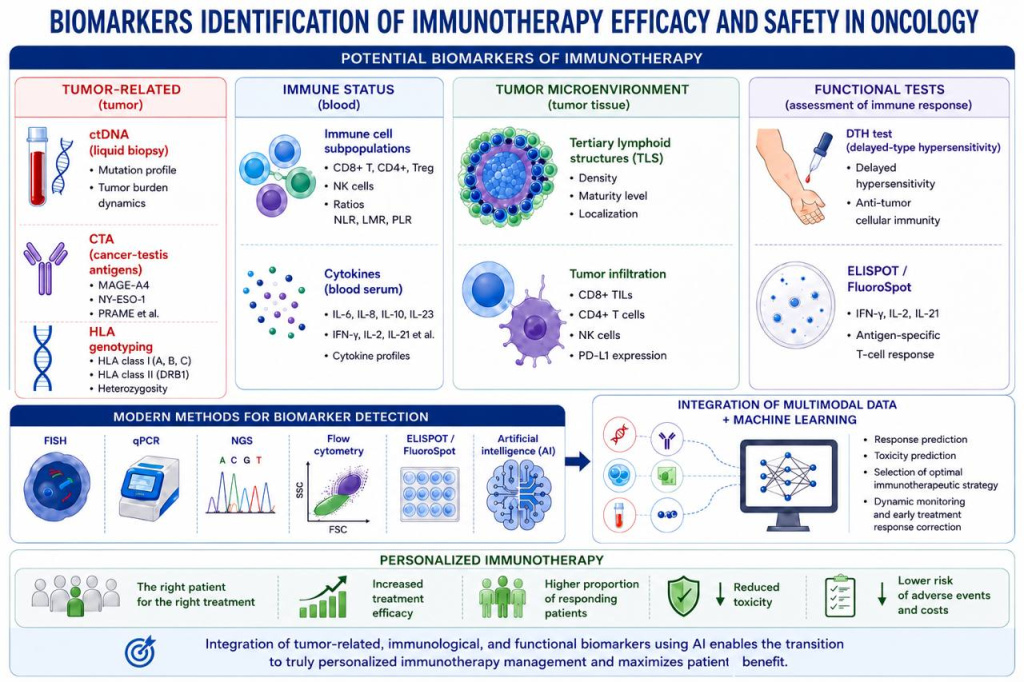
Настоящий обзор посвящен анализу современных иммунологических подходов к поиску биомаркеров, ассоциированных с эффективностью и безопасностью иммунотерапии злокачественных новообразований (ЗНО). Рассмотрены биомаркеры, связанные с опухолью, системные и локальные иммунные параметры (клеточный состав, цитокиновый профиль), а также современные методы обнаружения биомаркеров и функциональные тесты, используемые для оценки специфического противоопухолевого ответа. На рисунке представлена схема основных типов биомаркеров эффективности и безопасности иммунотерапии в онкологии. Поиск проведен в базах PubMed, Scopus, Web of Science и eLibrary.ru (2015—2025) по ключевым словам: immunotherapy, solid malignant tumors, biomarkers, PD-1/PD-L1, HLA, cytokine profile, cancer-testis antigens, tumor microenvironment, tertiary lymphoid structures. Включены оригинальные исследования, систематические обзоры и клинические работы на русском или английском языке. Исключены единичные клинические случаи, тезисы и исследования на животных.
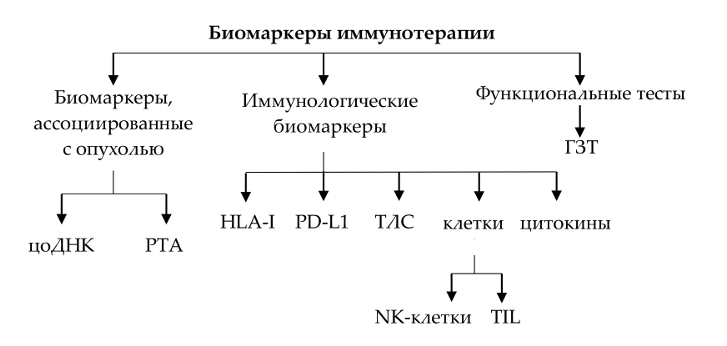
Рис. Схема основных типов биомаркеров эффективности и безопасности иммунотерапии в онкологии
Fig. Schematic overview of the main types of biomarkers associated with the efficacy and safety of immunotherapy in oncology
1. Биомаркеры, ассоциированные с опухолью
1.1. Молекулярно-генетические маркеры: циркулирующая опухолевая ДНК
Циркулирующая опухолевая ДНК (цоДНК) представляет собой небольшие фрагменты нуклеиновой кислоты (~160 п. н.) и обнаруживается в клетках опухолевой ткани у больных онкологическими заболеваниями. Она составляет лишь небольшую часть (0,1—10 %) свободно циркулирующей в крови нуклеиновой кислоты и образуется в результате гибели опухолевых клеток [4; 5]. Данная ДНК используется в качестве неинвазивного онкоиммунологического биомаркера [6]. Этот биомаркер отражает молекулярный профиль опухоли, поскольку характеризуется генетическими и эпигенетическими изменениями, которые присутствуют только в опухолевых клетках, и может быть обнаружен в таких жидкостях организма, как кровь, моча, кал, слюна, мокрота, конденсат выдыхаемого воздуха [7; 8]. Фрагментам цоДНК присущ малый период полужизни, что позволяет использовать их для мониторинга динамики болезни в реальном времени [9], а применение цифровой ПЦР и NGS дает возможность выявлять редкие мутации, что позволяет использовать цоДНК в качестве биомаркера для раннего обнаружения опухоли [10].
Данный показатель представляет собой важный маркер в ходе оценки эффективности иммунотерапии. Так, изменение его уровня связано с ответом опухоли на лечение и может использоваться в качестве биомаркера, определяющего клинический исход [11]. Снижение концентрации этих фрагментов в ходе терапии связано с увеличением общей выживаемости (ОВ), в то время как повышение концентрации — с прогрессированием заболевания [12]. Это было подтверждено в нескольких исследованиях. Так, было показано, что высокое содержание цоДНК понижает такие показатели, как ОВ и выживаемость без прогрессирования (ВБП) у пациентов с меланомой, проходящих иммунотерапию [7]. В случае изучения немелкоклеточного рака легкого метаанализ 52 исследований продемонстрировал, что обнаружение этого биомаркера связано со снижением безрецидивной выживаемости, где такой показатель, как отношение рисков (ОР), составлял 2,23 [8]. После лечения онкологических больных значение ОР доходило до 4,17, что было связано с ухудшением ОВ [8]. В то же время анализ 53 исследований с участием более 3700 пациентов с диффузной В-крупноклеточной лимфомой показал риск прогрессирования опухоли при высоком содержании цоДНК, где значение ОР достигало 2,5 [13]. Еще в одном исследовании было обнаружено, что анализ этой нуклеиновой кислоты в крови может выявлять прогрессирование опухоли на 140 дней раньше, чем другие подходы, в частности радиологические методы визуализации ЗНО [14].
Таким образом, цоДНК представляет собой клинически значимый биомаркер с высокой прогностической ценностью.
1.2. Раково-тестикулярные антигены
В основе адаптивного противоопухолевого иммунного ответа лежит презентация опухолеассоциированных антигенов — специфических пептидов, образующихся при злокачественной трансформации клеток. Раково-тестикулярные антигены (РТА) представляют собой большое семейство белков, которые экспрессируются не только в яичке и плаценте, но и аберрантно активируются в различных опухолях [15; 16]. Гены, относящиеся к одному подсемейству РТА, как правило, локализуются кластерно в соседних участках хромосом и кодируют белки со сходной доменной организацией и структурными характеристиками.
Прогностическое значение РТА варьируется в зависимости от типа опухоли. Согласно данным недавнего метаанализа, повышенный уровень экспрессии MAGE-A4, NY-ESO-1 и LAGE-1 при раке желудка связан с плохим прогнозом (ОР 1,5—2,5) [17]. Высокая экспрессия NY-ESO-1 ассоциирована со снижением общей выживаемости (ОР = 2,15; 95 % ДИ 1,42—3,27; p = 0,0003) [18]. Одновременная экспрессия нескольких РТА также коррелирует со снижением ВБП: ОР = 1,89 (95 % ДИ 1,28—2,79; p = 0,001) [18]. Данные обзорных исследований подтверждают, что прогностическое значение РТА зависит от гистологического типа сарком, что объясняется различной частотой экспрессии этих антигенов при разных новообразованиях [19].
В опухолевых тканях представители одного подсемейства РТА нередко коэкспрессируются и участвуют в реализации сходных клеточных функций. В частности, белки семейства антигенов меланомы (MAGE) содержат высококонсервативный домен гомологии MAGE (MHD), который играет значимую роль в клеточном ответе на стрессовые воздействия, а также вовлечен в процессы опухолевой прогрессии. Широкая экспрессия MAGE при различных типах злокачественных новообразований послужила основой для разработки терапевтических вакцин, часть из которых уже находится на стадии клинических испытаний для лечения меланомы, рака легкого и других онкологических заболеваний [20]. Углубленное изучение структурно-функциональных характеристик подсемейств РТА представляет собой перспективное направление для идентификации высокоспецифичных мишеней иммунотерапии.
Клиническая значимость РТА как мишеней подтверждается успехами иммунотерапии. В августе 2024 г. FDA впервые одобрило TCR-T-препарат afamitresgene autoleucel, направленный против MAGE-A4, для HLA-A*02-положительных пациентов с синовиальной саркомой. В исследовании SPEARHEAD-1 объективный ответ достиг 39—43 %, а медиана длительности ответа превысила 11 месяцев [21]. Метаанализ 73 клинических исследований РТА-вакцин (n = 1435) подтвердил скромную, но статистически значимую пользу: общий показатель объективного ответа составил 13 %, показатель контроля заболевания — 39 %. В рандомизированных исследованиях отмечено улучшение общей выживаемости (ОР = 0,80) без значимого влияния на безрецидивную выживаемость [22]. Эти данные подчеркивают, что высокий уровень экспрессии РТА не только прогностически важен, но и открывает путь к созданию высокоэффективных персонализированных вакцин.
Таким образом, можно ожидать, что высокий уровень экспрессии РТА в опухоли ассоциирован с более выраженным иммунным ответом на эти антигены и, как следствие, с большей эффективностью нацеленных на них методов терапии. Поэтому определение экспрессии РТА у онкологических пациентов целесообразно для выбора оптимальной стратегии лечения.
2. Антигены главного комплекса гистосовместимости (HLA)
Особую роль в диагностике онкологических заболеваний играют антигены главного комплекса гистосовместимости (HLA). Локус HLA (человеческий лейкоцитарный антиген) представляет собой высокополиморфный кластер генов, расположенный на коротком плече 6-й хромосомы (6p21.3). HLA подразделяется на три класса — I, II и III, каждый из которых выполняет свои функции в иммунной системе.
Поскольку основные вариации сосредоточены в экзонах, кодирующих пептидсвязывающую бороздку и участок взаимодействия с Т-клеточным рецептором (ТКР), различия в структуре молекул HLA определяют их разную избирательность в связывании пептидов [23]. Таким образом, вариации в генах HLA обеспечивают презентацию чрезвычайно разнообразной группы пептидов как CD4+, так и CD8+ Т-клеткам. Генетический полиморфизм молекул HLA играет ключевую роль в презентации опухолевых антигенов и формировании противоопухолевого иммунного ответа.
В зависимости от аллельного варианта HLA в процессе иммунного ответа презентируются различные пептидные фрагменты (эпитопы), при этом их количество и аффинность связывания с HLA и ТКР неодинаковы, что ведет к разной иммунной реактивности [24; 25]. Изучение взаимосвязи генетического варианта HLA и мутационного ландшафта опухолей позволяет предположить влияние аллельного типа HLA на иммуноредактирование опухоли, в связи с чем определение генетических вариантов HLA I класса рассматривается как важный инструмент для оценки иммуногенности опухоли и прогнозирования эффективности иммунотерапии [26; 27].
Кроме того, при анализе локусов HLA класса I (A/B/C) у пациентов с саркомами мягких тканей выявлена связь определенных аллелей с ОВ и ВБП. Наличие аллелей HLA-A02, B18 и C*07 у пациентов с саркомами мягких тканей ассоциировано со снижением ОВ и ВБП. Аллели HLA-A*02, B40 и C03 также связаны со снижением ОВ у пациентов с меланомой и снижением ВБП у пациентов с саркомой мягких тканей [28]. Таким образом, вариабельность молекул HLA, благодаря их центральной роли в иммунном ответе, может служить прогностическим и предиктивным маркером при иммунотерапии опухолей.
Недавние результаты метаанализов показали, что уровень экспрессии HLA, а также его генетический полиморфизм и гетерозиготность имеют важное значение для выживаемости пациентов и эффективности иммунотерапии. Так, результаты метаанализа продемонстрировали значимость отдельных аллелей. Обнаружение HLA-A*03 было связано с худшей выживаемостью при терапии ингибиторами контрольных точек (immune checkpoint inhibitors, ICI): значение ОР для ОВ и ВБП составляло 1,3—1,5, однако при отсутствии иммунотерапии аналогичной ассоциации не выявлено [29; 31].
Таким образом, продемонстрировано, что HLA может использоваться в качестве как прогностического, так и предиктивного биомаркера в онкоиммунологии.
3. Белок PD-1 и его лиганды (PD-L1/PD-L2)
PD-1 представляет собой трансмембранный белок, экспрессирующийся на поверхности Т-лимфоцитов, В-клеток и NK-клеток, тогда как его лиганды (PD-L1 и PD-L2) обнаруживаются на опухолевых и иммунных клетках. Взаимодействие PD-1 со своими лигандами лежит в основе уклонения опухоли от иммунного ответа [30]. Блокада данного сигнального пути лежит в основе иммунотерапии, направленной на ингибирование контрольных точек иммунного ответа, и позволяет увеличить общую выживаемость онкологических пациентов [31]. Так, использование ингибиторов сигнального пути PD-1/PD-L1 позволило увеличить ОВ пациентов с немелкоклеточным раком легкого, меланомой и раком почки [32]. В настоящее время PD-1/PD-L1 используется также в качестве биомаркера для прогнозирования эффективности иммунотерапии. Высокий уровень экспрессии PD-L1 связан с повышенной чувствительностью опухоли к иммунотерапии ICI [33]. Например, при высокой экспрессии PD-L1 частота объективного ответа может достигать 45 %, тогда как при низкой экспрессии она составляет менее 15 % [34]. Однако даже при высоком уровне экспрессии PD-L1 повышенная эффективность иммунотерапии наблюдается не всегда [35].
Таким образом, сигнальный путь PD-1/PD-L1 играет ключевую роль в механизмах уклонения опухоли от иммунного надзора. Его блокада с помощью ICI является эффективной стратегией иммунотерапии, улучшающей ОВ при ряде ЗНО. Хотя уровень экспрессии лиганда PD-L1 служит важным прогностическим биомаркером ответа на терапию, его предсказательная ценность ограничена, поскольку высокая экспрессия не всегда гарантирует клиническую эффективность.
4. Третичные лимфоидные структуры
Третичные лимфоидные структуры (ТЛС) представляют собой лимфоидные агрегаты, которые обнаруживаются в микроокружении солидных опухолей в условиях хронического воспаления. В настоящее время ТЛС рассматриваются в качестве перспективных биомаркеров в онкоиммунологии. Идентификация ТЛС отражает функциональное состояние адаптивного иммунного ответа на уровне микроокружения опухоли. Обнаружение данных структур в ткани опухоли, как правило, связано с благоприятным прогнозом и улучшенным ответом на иммунотерапию [36].
Однако многочисленные исследования показали, что прогностическое значение ТЛС в значительной степени зависит от их зрелости, плотности и пространственного расположения. Степень зрелости ТЛС определяет их функциональную активность. Так, Т- и В-клетки, входящие в состав незрелых ТЛС, часто не способны обеспечивать полноценный иммунный ответ, тогда как зрелые ТЛС с герминативными центрами представляют собой место пролиферации и дифференцировки В-клеток, продукции высокоавидных антител и активации Т-клеточного ответа [37]. В крупном ретроспективном полногеномном анализе ЗНО наличие зрелых ТЛС было связано с улучшенной выживаемостью и ответом на иммунотерапию вне зависимости от экспрессии PD-L1 или плотности CD8+ Т-клеток [38].
ТЛС можно использовать в качестве биомаркера ответа на иммунотерапию, особенно на фоне применения ICI [39]. Во Франции в 2022 г. было проведено многоцентровое исследование PEMBROSARC (фаза II), в ходе которого была осуществлена проспективная валидация ТЛС как предиктивного биомаркера [40]. У пациентов с ТЛС-положительными опухолями наблюдались значительно более высокие показатели объективного ответа, ВБП и ОВ. Например, ВБП у таких пациентов составила 40 % по сравнению с 4,9 % в группе пациентов, отобранных без учета ТЛС-статуса [40].
На сегодняшний день использование ТЛС в качестве биомаркера в рутинной клинической практике связано с рядом трудностей, одна из которых — отсутствие стандартизированных подходов к их оценке [41]. Тем не менее недавно были предложены первые унифицированные подходы. Так, окрашивание гематоксилином-эозином и обнаружение герминативных центров в сочетании с иммуногистохимическим выявлением CD20+ B-клеточных зон и CD23+ фолликулярных дендритных клеток дает возможность идентифицировать зрелые ТЛС в различных типах опухолей [36]. Активно разрабатываются алгоритмы глубокого обучения для автоматизированной оценки ТЛС [42; 43]. Однако не все ТЛС функционально эквивалентны: существуют и иммуносупрессивные варианты. Например, у пациентов с гепатоцеллюлярной карциномой наблюдались нарушения метаболизма, блокирующие дифференцировку В-клеток и созревание ТЛС. В данном случае обнаружение ТЛС было связано с прогрессией опухоли [44]. Кроме того, есть опухоли, в которых ТЛС встречаются редко. Так, лишь приблизительно у 15 % пациентов с глиобластомой обнаруживаются ТЛС, часто локализованные вблизи мозговых оболочек или желудочков [38]. Это ограничивает использование ТЛС в качестве биомаркера при определенных нозологических формах ЗНО.
5. Биомаркеры системного и локального иммунного ответа
5.1. Анализ субпопуляционного состава иммунных клеток в опухоли и периферической крови
Результаты недавно выполненных метаанализов демонстрируют связь высокой плотности TIL, особенно CD8+ клеток, с улучшением ОВ и ВБП [45]. Метаанализы по изучению иммунорегуляторных клеток показали противоположные результаты. Так, обнаружение Treg (FoxP3+) было связано с неблагоприятным прогнозом (ОР 1,45—1,92) и подавлением цитотоксического иммунного ответа.
Циркулирующие иммунные клетки также обладают прогностической значимостью. Результаты метаанализа продемонстрировали, что повышенные уровни NK-клеток могут быть связаны с улучшением прогноза: значение ОР для ОВ составило 0,34 [46].
Для оценки противоопухолевого иммунитета традиционно используется определение количественного содержания и субпопуляционного состава клеток иммунной системы как в опухолевом микроокружении, так и в периферической крови. Присутствие эффекторных клеток в опухолевом очаге, их локализация и отсутствие иммуносупрессорных популяций связаны с реализацией эффективного иммунного ответа [47]. Т-хелперы представляют собой гетерогенную группу клеток и могут как стимулировать, так и подавлять активность иммунной системы. Известно, что Th2-клетки участвуют в активации M2-макрофагов, способствующих росту опухоли [48].
Другая группа исследователей показала, что иммунологическая оценка опухолевого микроокружения отражает его функциональное состояние и позволяет идентифицировать подгруппы пациентов с различной чувствительностью к иммунотерапии. Интеграция иммунных и клинико-патологических параметров обеспечивает значимое улучшение прогностической точности, что подчеркивает необходимость внедрения иммунных биомаркеров в клиническую практику [49]. Кроме того, данные метаанализа подтверждают корреляцию наличия CD3+ и CD8+ Т-клеток в опухоли с улучшением выживаемости [50].
Изучение субпопуляционного состава периферической крови также дает важную информацию. Так, отношение количества нейтрофилов к лимфоцитам (NLR) служит прогностическим фактором при различных солидных опухолях [51]. Аналогичное значение показано для соотношения лимфоцитов и моноцитов [52; 53]. Субпопуляционный состав лимфоцитов у онкологических пациентов отличается от такового у здоровых лиц. В масштабной оценке иммунных статусов 558 пациентов (3040 измерений), проведенной в НМИЦ онкологии им. Н. Н. Петрова, лишь в 0,1 % наблюдений показатели были в пределах нормы: в 51,7 % отмечалось снижение относительного количества лимфоцитов, часто наблюдалось уменьшение содержания CD3+, CD4+ и CD8+ Т-лимфоцитов, увеличение количества CD4+CD8+ клеток и доли Treg [54]. Важной практической задачей остается определение границ значимости изменений этих параметров.
Таким образом, анализ клеточного состава иммунной системы в опухоли и периферической крови позволяет оценить локальный и системный противоопухолевый ответ и в комбинации с другими методами формирует комплексную картину, необходимую для прогнозирования эффективности терапии.
5.2. Цитокиновый профиль и растворимые факторы
Цитокиновый профиль опухолевого микроокружения имеет большое значение в регуляции взаимодействия опухолевых клеток с компонентами иммунной системы, оказывая влияние на развитие опухоли, метастазирование и эффективность терапии [55]. Оценка специфического противоопухолевого иммунного ответа предполагает определение поляризации иммунного микроокружения в направлении противоопухолевого фенотипа, что связано с определенным профилем секреции цитокинов. IL-2 выполняет двойственную функцию: с одной стороны, он активирует пролиферацию Т-лимфоцитов и NK-клеток, усиливая противоопухолевый иммунитет; с другой — в высоких концентрациях IL-2 может способствовать прогрессии опухоли [55].
IL-6 участвует в активации сигнального пути JAK/STAT3 и пролиферации опухолевых клеток, а также подавляет иммунный ответ, способствуя развитию ЗНО. IL-8 играет важную роль в ангиогенезе, инвазии и метастазировании. Повышенное содержание этих цитокинов связано с неблагоприятным прогнозом [55; 56]. Также показано, что IL-10 способствует уклонению опухоли от иммунной системы, подавляя противоопухолевый иммунный ответ. Однако выявлено, что в некоторых случаях данный цитокин может подавлять развитие сосудов, питающих опухоль и способствующих ее развитию [55].
В исследованиях у пациентов с меланомой, получавших комбинацию ниволумаба и ипилимумаба, установлено, что высокий уровень IL-23 связан с устойчивым клиническим ответом на терапию (ОР = 3,47; 95 % ДИ 1,22—9,85; р = 0,019) [57], в то время как высокий уровень IL-10 ассоциирован с его отсутствием (ОР = 0,27; 95 % ДИ 0,10—0,74; р = 0,011) [57]. Высокий исходный уровень IL-8 (≥ 23 pg/mL) коррелирует с меньшей эффективностью ICI [58]. Более того, повышенное содержание IL-6 и IL-8 связано с развитием нежелательных явлений [59]. Другое крупное семейство цитокинов — хемокины — способствует привлечению CD8+ Т-лимфоцитов в микроокружение опухоли. Повышенное содержание этих молекул связано с формированием так называемых «горячих» опухолей, которые характеризуются высокой иммунной инфильтрацией и благоприятным клиническим прогнозом [60].
Таким образом, определение профиля цитокинов и других сигнальных молекул дает важную информацию о состоянии иммунной системы пациента с ЗНО, процессах взаимодействия опухоли с микроокружением и позволяет прогнозировать ответ на иммунотерапию, а также оценивать ее эффективность.
6. Реакция гиперчувствительности замедленного типа
Реакция гиперчувствительности замедленного типа (ГЗТ) широко используется для оценки эффективности активации клеточного иммунного ответа при иммунотерапии, особенно вакцинотерапии. Тест заключается во внутрикожном введении небольших количеств опухолевого антигена. В ответ антиген-презентирующие клетки кожи секретируют цитокины, привлекающие CD4+ Т-клетки памяти, которые активируют макрофаги и цитотоксические лимфоциты. Возникающая эритема и/или уплотнение оцениваются через 24—72 ч. Дополнительно возможно проведение биопсии кожи с иммуногистохимическим окрашиванием для выявления антиген-специфичных Т-лимфоцитов [61].
Благодаря доступности и простоте выполнения метод накопил обширную базу клинических данных. Корреляция положительной реакции ГЗТ с улучшением общей выживаемости показана при вакцинотерапии глиомы [62] и рака поджелудочной железы [63], рака почки [64] и меланомы [65].
В исследовании Т. Л. Нехаевой и соавт. (2024) была проведена оценка прогностического значения реакции ГЗТ у 277 пациентов с меланомой (n = 143) и саркомами мягких тканей (n = 134), получавших аутологичную дендритно-клеточную вакцину (ДКВ). Конверсия реакции ГЗТ (увеличение размера папулы более чем на 10 мм на фоне терапии) была признана независимым прогностическим фактором. В многофакторной регрессионной модели Кокса наличие конверсии ГЗТ снижало риск смерти на 46 % (95 % ДИ 21—64 %; p = 0,02) и риск прогрессирования на 39 % (95 % ДИ 20—55 %; p = 0,001). Полученные данные свидетельствуют о возможности использования реакции ГЗТ для оценки эффективности иммунотерапии, в частности вакцинотерапии ДКВ [65].
В рандомизированном исследовании с участием 42 пациентов, в котором сравнили иммунологическую эффективность аутологичных ДКВ и вакцин на основе опухолевых клеток, положительная реакция ГЗТ была связана с более длительной выживаемостью: медиана составила 43,4 месяца по сравнению с 20,5 месяца (95 % ДИ от 18,6 до > 60 против 9,3—32,3 месяца) и снижением риска смерти на 70 % (ОР = 0,304; p = 0,0053; 95 % ДИ 0,131—0,702). Наиболее распространенными нежелательными явлениями были местные реакции в месте инъекции от легкой до умеренной степени тяжести и гриппоподобные симптомы, однако при применении аутологичных вакцин на основе опухолевых клеток нежелательные явления 2-й степени тяжести возникали чаще [66].
В 2023 г. при терапии ДКВ против WT1 (Wilms Tumor 1) у пациентов с глиомой положительная реакция ГЗТ динамически коррелировала с улучшением иммунного профиля (снижение отношения нейтрофилов к лимфоцитам, NLR) и напрямую отражала состояние противоопухолевого иммунитета, что делает тест перспективным неинвазивным индикатором. Это подтверждает потенциал ГЗТ не только как скринингового, но и как динамического биомаркера для мониторинга клеточной иммунотерапии. Согласно данным обзора, опубликованного в 2023 г., применение WT1-направленных ДКВ сопровождается индукцией WT1-специфического иммунного ответа, при этом положительная реакция ГЗТ у пациентов коррелирует с клинической эффективностью [67]. Однако в других работах такой корреляции выявлено не было.
Противоречивость результатов может быть связана с различиями иммуномодулирующих сигналов в микроокружении опухоли и периферических тканях. К недостаткам метода относятся отсутствие стандартизированной дозы антигена и порога положительного ответа, что ведет к вариабельности результатов. Кроме того, положительный ответ может быть неспецифическим (например, на компоненты вакцины), а у части пациентов без внешних проявлений ГЗТ в биоптатах наблюдается Т-клеточная инфильтрация [68]. В связи с низкой специфичностью реакция ГЗТ может рассматриваться лишь как метод предварительного скрининга, результаты которого требуют подтверждения более точными иммунологическими тестами.
С учетом разнородности рассмотренных биомаркеров — от молекулярно-генетических (цоДНК, РTA) до клеточных (TIL, ТЛС) и гуморальных (цитокины, HLA) — нами была составлена сравнительная характеристика их прогностической значимости, а также чувствительности/специфичности. Данные систематизированы в таблице.
Сравнительная характеристика биомаркеров эффективности
и безопасности иммунотерапии в онкологии
Comparative analysis of biomarkers of the efficacy
and safety of immunotherapy in oncology
|
Биомаркер |
Тип |
Прогностическая значимость |
Чувствительность / специфичность |
Основные ограничениия |
Ключевые исследования |
|
цоДНК |
Биомаркер, ассоциированный с опухолью (молекулярно-генетический) |
Высокий уровень связан со снижением ОВ и ВБП. Снижение уровня во время терапии коррелирует с ответом на лечение |
Высокая аналитическая чувствительность при использовании ПЦР и NGS |
Требуются стандартизированные методы анализа |
Chen et al., 2025 [8]; Schroeder et al., 2024 [12]; Forghani et al., 2025 [13] |
|
РТА (MAGE-A4, NY-ESO-1, LAGE-1) |
Биомаркер, ассоциированный с опухолью |
Высокая экспрессия связана с неблагоприятным клиническим течением заболевания и худшими показателями выживаемости |
Средняя. Зависит от типа опухоли и уровня экспрессии |
Зависимость от типа опухоли |
Wang et al., 2019 [18]; D’Angelo et al., 2024 [22] |
|
HLA-I |
Иммунологический маркер |
Отдельные аллели (например, HLA-A*03) ассоциированы с худшей выживаемостью при ICI; гетерозиготность может повышать эффективность терапии |
Умеренная |
Вариабельность |
Naranbhai et al., 2022 [29]; Correale et al., 2020 [26]; Tanegashima et al., 2024 [27] |
|
PD-L1 |
Иммунологический биомаркер |
Высокая экспрессия связана с большей вероятностью ответа на ингибиторы контрольных точек |
Ограниченная |
Низкая специфичность |
Zhang et al., 2025 [33]; Oisakede et al., 2025 [34] |
|
ТЛС |
Иммунологический биомаркер |
Очень высокая. Наличие зрелых ТЛС связано с улучшением ОВ, ВБП и ответа на ICI |
Высокая в случае ряда опухолей |
Нет единых критериев оценки зрелости |
Italiano et al., 2022 [40]; Liu et al., 2025 [38] |
|
CD8+ TIL |
Иммунный инфильтрационный маркер микроокружения опухоли |
Высокая. Высокая плотность связана с улучшением ОВ и ВБП |
Высокая чувствительность в случае выявления «горячих» опухолей |
Зависимость от методики подсчета |
Gooden M.J.M. et al., 2011 [50] |
|
NK-клетки |
Иммунологический биомаркер |
Высокая. Высокое содержание связано с лучшей ОВ |
Умеренная |
Зависимость от методики подсчета |
Nersesian et al., 2021 [46] |
|
IL-6 |
Цитокиновый биомаркер |
Средняя. Повышенный уровень связан с прогрессированием опухоли и токсичностью ICI |
Умеренная |
Высокая изменчивость |
Wang et al., 2021 [56] |
|
IL-8 |
Цитокиновый биомаркер |
Средняя. Высокий уровень связан с низкой эффективностью ICI и неблагоприятным прогнозом |
Высокая |
Высокая изменчивость |
Wang et al., 2021 [56] |
|
IL-10 |
Цитокиновый биомаркер |
Средняя. Низкий уровень ассоциирован с лучшим ответом на иммунотерапию |
Умеренная |
Высокая изменчивость |
Wang et al., 2021 [56]; Chen et al., 2025 |
|
IL-23 |
Цитокиновый биомаркер |
Средняя. Высокий уровень ассоциирован с устойчивым клиническим ответом на иммунотерапию |
Умеренная |
Высокая изменчивость |
Wang et al., 2021 [56] |
|
ГЗТ |
Функциональный иммунологический тест |
Низкая. Положительная реакция связана с увеличением ОВ и снижением риска прогрессирования |
Высокая чувствительность, но низкая специфичность |
Низкая специфичность |
Nekhaeva et al., 2024 [65]; Ogasawara et al., 2024 [67] |
7. Современные методы обнаружения биомаркеров
Выявление биомаркеров эффективности и безопасности иммунотерапии может быть затруднено из-за их низкой концентрации в анализируемых образцах. В настоящее время для обнаружения биомаркеров ЗНО используются методы проточной цитофлюориметрии (включая внутриклеточное окрашивание), ИФА и его модификация ELISPOT (enzyme-linked immunospot), количественная ПЦР, FISH, а также мультиплексные иммунологические методы.
При использовании FISH флуоресцентно-меченый зонд гибридизуется с ДНК для обнаружения изменений числа копий гена (например, амплификации гена HER2) или слияния генов в опухолевых клетках. Выделяют также многоцветный FISH (спектральное кариотипирование), позволяющий идентифицировать одновременно все хромосомы за счет уникального окрашивания каждой из них. Данный метод характеризуется высокой чувствительностью и позволяет выявлять хромосомные аномалии. Многоцветный FISH может быть использован для обнаружения биомаркеров, диагностирующих и прогнозирующих эффективность лечения, особенно при гематологических злокачественных новообразованиях, саркомах, карциномах и опухолях головного мозга [69].
Особое место в онкоиммунологии занимает ELISPOT — высокочувствительный метод обнаружения и подсчета клеток, секретирующих индивидуальные белки in vitro. Метод предназначен для идентификации и определения количества клеток, секретирующих цитокины. Высокая разрешающая способность ELISPOT позволяет оценивать антиген-стимулированную продукцию цитокинов, что крайне важно для оценки специфического противоопухолевого иммунного ответа [70]. К преимуществам метода ELISPOT относятся определение продукции цитокинов на уровне каждой отдельной клетки, что дает возможность вычислять частоту цитокин-продуцирующих клеток; более высокая чувствительность по сравнению с ИФА (ELISPOT способен выявлять одну цитокин-продуцирующую клетку среди 300 000 клеток популяции); возможность исследования живых клеток, а не биологических жидкостей (в отличие от ИФА); объективный и быстрый анализ количества цитокин-продуцирующих клеток (пятен, spots) и относительного количества цитокина на одну клетку (размера пятна). Таким образом, метод дает как качественную (тип иммунного белка), так и количественную (число отвечающих клеток) информацию [71; 72].
Благодаря уникально высокой чувствительности ELISPOT-анализа идентификация малочисленных клеточных популяций (например, при антиген-специфических ответах), которая ранее была недоступна, стала относительно простой задачей. Высокая чувствительность во многом обусловлена тем, что детектируемый продукт в момент анализа находится на поверхности секретирующей клетки (будучи связан с ее рецепторами) до того, как он растворится в супернатанте или деградирует [72]. Это делает ELISPOT значительно более чувствительным, чем ИФА, и полезным для мониторинга антиген-специфических ответов в различных областях иммунологии: исследования рака, трансплантация органов, инфекционные и аутоиммунные заболевания, разработка вакцин [73]. На сегодняшний день существует модификация данного метода, FluoroSpot, дающая возможность одновременно выявлять несколько цитокинов, что позволяет более детально проанализировать функциональность иммунной системы [74].
В онкологии ELISPOT применяется для определения эффективности антиген-специфического лечения (по выработке интерферона-гамма, интерлейкинов, гранзима В, перфорина и других цитокинов иммунокомпетентными клетками), а также для подбора дозы, длительности и сроков введения препарата у больных, получающих клеточную иммунотерапию, химиотерапию или комбинированное лечение.
Помимо ELISPOT в настоящее время разрабатываются новые методы машинного обучения, позволяющие диагностировать онкологические заболевания. Так, подход TARGETS на основе искусственного интеллекта позволяет диагностировать и прогнозировать реакцию на конкретные лекарственные препараты [75]. Кроме того, проводятся испытания биосенсоров для повышения чувствительности и специфичности обнаружения биомаркеров. Биосенсоры представляют собой устройства, регистрирующие биомаркер с помощью химического процесса, который преобразуется датчиком в электрический сигнал с последующей обработкой и усилением. Разрабатываемые биосенсоры могут быть использованы для выявления таких биомаркеров ЗНО, как циркулирующая опухолевая ДНК, РНК, микроРНК (например, miR-141 в сыворотке крови больных раком предстательной железы) [76], метилирование ДНК в цоДНК [77], белки, циркулирующие опухолевые клетки в биологических жидкостях [78]. Недавно был описан новый биосенсор на основе флуоресцентного резонансного переноса энергии (FRET), позволяющий выявлять РНК теломеразы в опухолевых клетках молочной железы [79]. Данный подход дает возможность выявлять опухолевые клетки и осуществлять раннюю диагностику онкологических заболеваний. Для обнаружения биомаркеров ЗНО также разрабатываются микрофлюидные чипы [80], например существуют микрофлюидные чипы для выявления белков, ассоциированных с раком полости рта [81].
Заключение
Представленные в обзоре данные свидетельствуют о том, что современная онкоиммунология располагает широким спектром потенциальных биомаркеров, ассоциированных с эффективностью и безопасностью иммунотерапии. Генетические особенности системы HLA, цоДНК, экспрессия РТА, сигнальный путь PD1/PD-L1, ТЛС, клеточный состав опухолевого микроокружения и субпопуляционный состав периферической крови, цитокиновый профиль и реакция ГЗТ — каждый из этих подходов отражает отдельные грани сложного взаимодействия опухоли и иммунной системы.
Критическое сравнение прогностической силы различных биомаркеров показывает их существенную неоднородность. Наиболее высокую предсказательную ценность демонстрируют третичные лимфоидные структуры (ТЛС) и динамические показатели циркулирующей опухолевой ДНК (цоДНК), в то время как рутинно используемый PD-L1 характеризуется ограниченной специфичностью и внутриопухолевой гетерогенностью. Цитокиновые маркеры (IL-6, IL-8) отражают текущий воспалительный статус, но страдают от высокой изменчивости, а HLA-генотипирование, хотя и стабильно, обладает умеренной прогностической силой, ограниченной определенными аллелями.
Ни один из рассмотренных маркеров на сегодняшний день не обладает достаточной предсказательной силой для рутинного клинического использования в качестве единственного прогностического критерия. Основными ограничениями являются гетерогенность опухолей, вариабельность иммунного статуса пациентов и отсутствие стандартизации методологии. Перспективным направлением представляется интеграция данных, полученных разными методами — особенно комбинация ТЛС (исходная стратификация) и цоДНК (динамический мониторинг), — с применением алгоритмов машинного обучения для построения комплексных прогностических моделей для каждого пациента.
Особую важность решение этой проблемы приобретает в контексте развития клеточной иммунотерапии (ДКВ, CAR-T, TCR-T, TIL), где контроль качества клеточного продукта, его персистенции и функциональной активности требует разработки специфических динамических биомаркеров. Дальнейшие проспективные исследования, направленные на валидацию комбинированных панелей биомаркеров, в сочетании с интеграцией HLA-генотипирования, цитокинового профиля и ГЗТ-тестов с ИИ-моделями, позволят перейти к истинно персонализированному управлению иммунотерапией, максимизируя эффективность и пользу для пациентов с солидными опухолями при одновременном снижении ее токсичности.
Reference
1. Larsson A. M., Nordström O., Johansson A., Rydén L., Leandersson K., Bergen-felz C. Peripheral Blood Mononuclear Cell Populations Correlate with Outcome in Patients with Metastatic Breast Cancer. Cells. 2022, 11(10), 1639, DOI: 10.3390/cells11101639.
2. Liu D., Che X., Wang X., Ma C., Wu G. Tumor Vaccines: Unleashing the Power of the Immune System to Fight Cancer. Pharmaceuticals (Basel). 2023, 16(10), 1384, DOI: 10.3390/ph16101384.
3. Shi G., Scott M., Mangiamele C. G., Heller R. Modification of the Tumor Microenvi-ronment Enhances Anti-PD-1 Immunotherapy in Metastatic Melanoma. Pharmaceutics. 2022, 14(11), 2429, DOI: 10.3390/pharmaceutics14112429.
4. Lanman R. B., Mortimer S. A., Zill O. A., Sebisanovic D., Lopez R., Blau S., et al. Analytical and clinical validation of a digital sequencing panel for quantitative, highly accurate evaluation of cell-free circulating tumor DNA. PLoS One. 2015, 10(10), e0140712, DOI: 10.1371/journal.pone.0140712.
5. Elazezy M., Joosse S. A. Techniques of using circulating tumor DNA as a liquid biopsy component in cancer management. Comput. Struct. Biotechnol. J. 2018, 16, 370—378, DOI: 10.1016/j.csbj.2018.10.002.
6. Hitchen N., Shahnam A., Tie J. Circulating Tumor DNA: A Pan-Cancer Bi-omarker in Solid Tumors with Prognostic and Predictive Value. Annual Review of Medicine. 2025, 76(1), 207—223, DOI: 10.1146/annurev-med-100223-090016.
7. Martínez-Vila C., Teixido C., Aya F., Martín R., González-Navarro E. A., Alos L., et al. Detection of Circulating Tumor DNA in Liquid Biopsy: Current Techniques and Poten-tial Applications in Melanoma. Int. J. Mol. Sci. 2025, 26(2), 861, DOI: 10.3390/ijms26020861.
8. Chen X., Zhang M., Zhou Q., Guo N., Cao B., Zeng H., et al. Circulating tumor DNA as prognostic markers of non-small cell lung cancer (NSCLC): a systematic review and meta-analysis. Translational Lung Cancer Research. 2025, 14(12), 5491—5508, DOI: 10.21037/tlcr-2025-900.
9. Panet F., Parakonstantinou A., Borrell M., Vivancos J., Vivancos A., Oliveira M. Use of ctDNA in early breast cancer: analytical validity and clinical potential. NPJ Breast Cancer. 2024, 10(1), 50, DOI: 10.1038/s41523-024-00653-3.
10. Slusher N., Jones N., Nonaka T. Liquid biopsy for diagnostic and prognostic eval-uation of melanoma. Front. Cell Dev. Biol. 2024, 12, 1420360, DOI :10.3389/fcell.2024.1420360.
11. Sánchez-Herrero E., Serna-Blasco R., Robado de Lope L., González-Rumayor V., Romero A., Provencio M. Circulating Tumor DNA as a Cancer Biomarker: An Overview of Biological Features and Factors That may Impact on ctDNA Analysis. Front. Oncol. 2022, 12, 943253, DOI: 10.3389/fonc.2022.943253.
12. Schroeder C., Gatidis S., Kelemen O., Schütz L., Bonzheim I., Muyas F., et al. Tumour-informed liquid biopsies to monitor advanced melanoma patients under immune checkpoint inhibition. Nat. Commun. 2024, 15(1), 8750, DOI: 10.1038/s41467-024-52923-0.
13. Forghani S., Shahsavand A., Samiee R., Kharaghani M., Kiumarsi A., Sabet F. M., et al. The prognostic ana clinical utility of circulating tumor DNA in diffuse large B-cell Lymphoma: a systematic review and meta-analysis. NPJ Precision Oncology. 2025, 9(1), 385, DOI: 10.1038/s41698-025-01174-3.
14. Avanzini S., Kurtz D. M., Chabon J. J., Moding E. J., Hori S. S., Gambhir S. S. A mathematical model of ctDNA shedding predicts tumor detection size. Sci. Adv. 2020, 6(50), eabc4308, DOI: 10.1126/sciadv.abc4308.
15. Alimardani M., Rahimi H., Ghasemi A., Moghbeli M., Gholamin M., Abbaszadegan M. R. Overexpression of cancer testis antigens in gastric cancer and their correlations with the patients’ clinicopathological characteristics. BMC Med. Genomics. 2025, 19(1), 25, DOI: 10.1186/s12920-025-02295-1.
16. Ren S., Zhang Z., Li M., Wang D., Guo R, Fang X., et al. Cancer testis antigen sub-families: Attractive targets for therapeutic vaccine (Review). Int. J. Oncol. 2023, 62(6), 71, DOI: 10.3892/ijo.2023.5519.
17. Alimardani M., Rahimi H., Ghasemi A., Moghbeli M., Gholamin M., Abbaszadegan M. R. Overexpression of cancer testis antigens in gastric cancer and their correlations with the patients’ clinicopathological characteristics. BMC Medical Genomics. 2026, 19(1), 25, DOI: 10.1186/s12920-025-02295-1.
18. Wang H., Chen D., Wang R., Quan W., Xia D., Mei J. NY-ESO-1 expression in solid tumors pre-dicts prognosis. Medicine. 2019, 98(48), e17990, DOI: 10.1097/MD.0000000000017990.
19. Salmaninejad A., Zamani M. R., Pourvahedi M., Golchehre Z., Bereshneh A. H., Rezaei N. Cancer/Testis Antigens: Expression, Regulation, Tumor Invasion, and Use in Immunotherapy of Cancers. Immunol. Invest. 2016, 45(7), 619—640, DOI: 10.1080/08820139.2016.1197241.
20. Alsalloum A., Shevchenko J., Sennikov S. The Melanoma-Associated Antigen Family A (MAGE-A): A Promising Target for Cancer Immunotherapy? Cancers. 2023, 15(6), 1779, DOI: 10.3390/cancers15061779.
21. D’Angelo S. P., Araujo D. M., Razak A. R. A., Agulnik M., Attia S., Blay J.-Y., et al. Afamitresgene autoleucel for advanced synovial sarcoma and myxoid round cell liposarcoma (SPREARHEAD-1): an inter-national, open-label, phase 2 trial. Lancet. 2024, 403(10435), 1460—1471, DOI: 10.1016/S0140-6736(24)00319-2.
22. Wood G. E., Meyer C., Petitprez F., D’Angelo S. P. Immunotherapy in Sarcoma: Current Data and Promising Strategies. ASCO Educ. Book. 2024, 44(3), e432234, DOI: 10.1200/EDBK_432234.
23. Dendrou C. A., Petersen J., Rossjohn J., Fugger L. HLA variation and disease. Nat. Rev. Immunol. 2018, 18, 325—339, DOI: 10.1038/nri.2017.143.
24. Abualrous E. T., Stricht J., Freund C. Major histocompatibility complrx (MHC) class I and class II proteins: impact of polymorphism on antigen presentation. Current Opinion in Immunology. 2021, 70, 95—104, DOI: 10.1016/j.coi.2021.04.009.
25. Ivanova M., Shivarov V. HLA genotyping meets response to immune checkpoint inhibitors prediction: A story just started. Int. J. Immunogenet. 2021, 48(2), 193—200, DOI: 10.1111/iji.12517.
26. Correale P., Saladino R. E., Giannarelli D., Giannicola R., Agostino R., Staropoli N., et al. Distinctive germline expression of class I human leukocyte antigen (HLA) alleles and DRB1 heterozygosis predict the outcome of patients with non-small cell lung cancer receiv-ing PD-1/PD-L1 immune checkpoint blockade. J. Immunother. Cancer. 2020, 8(1), e000733, DOI: 10.1136/jitc-2020-000733.
27. Tanegashima T., Shiota M., Fujiyama N., Narita S., Habuchi T., Fukuchi G., et al. Effect of HLA Genotype on Anti-PD-1 Antibody Treatment for Advanced Renal Cell Carci-noma in the SNiP-RCC Study. J. Immunol. 2024, 213(1), 23—28, DOI: 10.4049/jimmunol.2300308.
28. Nekhaeva T. L., Novik A. V., Girdyuk D. V., Danilova A. B., Savchenko P. A., Grigoryevskaya A. V., et al. Prognostic value of HLA class I expression in patients with cutaneous melanoma and soft tissue sarcomas treated with cancer-testis antigens-based vaccine. Explor Med. 2025, 6, 1001287, DOI: 10.37349/emed.2025.1001287.
29. Naranbhai V., Viard M., Dean M., Groha S., Braun D. A., Labaki C., et al. HLA-A*03 and response to immune checkpoint blockade in cancer: an epidemiological biomarker study. Lancet Oncol. 2022, 23(1), 172—184, DOI: 10.1016/S1470-2045(21)00582-9.
30. Mandal K., Barik G. K., Santra M. K. Overcoming resistance to anti-PD-L1 immuno-therapy: mechanisms, combination strategies, and future directions. Mol. Cancer. 2025, 24(1), 246, DOI: 10.1186/s12943-025-02400-z.
31. Neil V., Lee S. W. Advancing Cancer Treatment: A Review of Immune Check-point Inhibitors and Combination Strategies. Cancers (Basel). 2025, 17(9), 1408, DOI: 10.3390/cancers17091408.
32. Topalian S. L., Hodi F. S., Brahmer J. R., Gettinger S. N., Smith D. C., McDermott D. F., et al. Five-Year Survival and Correlates Among Patients With Advanced Melanoma, Renal Cell Carcinoma, or Non-Small Cell Lung Cancer Treated With Nivolumab. JAMA Oncol. 2019, 5(10), 1411—1420, DOI: 10.1001/jamaoncol.2019.2187.
33. Zhang J., Song Z., Zhang Y., Zhang C., Xue Q., Zhang G., et al. Recent advances in biomarkers for predicting the efficacy of immunotherapy in non-small cell lung cancer. Front. Immunol. 2025, 16, 1554871, DOI: 10.3389/fimmu.2025.1554871.
34. Oisakede E. O., Akinro O., Bello O. J., Analikwu C. C., Egbon E., Olawade D. B. Predictive models for immune checkpoint inhibitor response in cancer: A review of current ap-proaches and future directions. Crit. Rev. Oncol. Hematol. 2025, 216, 104980, DOI: 10.1016/j.critrevonc.2025.104980.
35. Li A., Luo L., Du W., Yu Z., He L., Fu S., et al. Deciphering transcriptomic determinants of the divergent link between PD-L1 and immunotherapy efficacy. NPJ Precis. Oncol. 2023, 7(1), 87, DOI: 10.1038/s41698-023-00443-3.
36. Hernández-Verdin I., Dimberg A., Thommen D. S., Engblom C., Vanhersecke L., Silina K., et al. Tertiary lymphoid structures in the era of cancer therapy. J. Exp. Clin. Cancer Res. 2026, 45(1), 48, DOI: 10.1186/s13046-026-03644-3.
37. Su G.-L., Zhang M.-J., Li H., Sun Z.-J. Dissecting Tertiary Lymphoid Structures in Cancer: Maturation, Localization and Density. Theranostics. 2025, 15(18), 9459—9485, DOI: 10.7150/thno.113940.
38. Liu Y.-M., Zhao K., Xie M., Bao X.-Y., Cai W.-H., Jin J.-M., et al. Density and maturity ratio of tertiary lymphoid structures in stage II-III non-small cell lung cancer predict postop-erative recurrence risk. Transl. Lung Cancer Res. 2025, 14(9), 3349—3362, DOI: 10.21037/tlcr-2025-477.
39. Hayashi Y., Makino T., Doki Y. Tertiary Lymphoid Structures as Predictive Bi-omarkers for Immune Checkpoint Inhibitor Therapy in Esophageal Cancer. Gan To Kagaku Ryoho. 2025, 52(9), 618—623, PMID: 41047768.
40. Italiano A., Bessede A., Pulido M., Bompas E., Piperno-Neumann S., Chevreau C., et al. Pembrolizumab in soft-tissue sarcomas with tertiary lymphoid structures: a phase 2 PEMBROSARC trial cohort. Nat. Med. 2022, 28(6), 1199—1206, DOI: 10.1038/s41591-022-01821-3.
41. Luis M.-E., Rhodes J. L., Marion V. C., Kemp R. A. Tertiary lymphoid structures in cancer — considerations for patient prognosis. Cell Mol. Immunol. 2020, 17(6), 570—575, DOI: 10.1038/s41423-020-0457-0.
42. van Rijthoven M., Obahor S., Pagliarulo F., van den Broek M., Schraml P., Moch H., et al. Multi-resolution deep learning characterizes tertiary lymphoid structures and their prognostic relevance in solid tumors. Commun. Med. (Lond). 2024, 4(1), 5, DOI: 10.1038/s43856-023-00421-7.
43. Le Rochais M., Brahim I., Zeghlache R., Redoulez G., Guillard M., Le Noac’h P., et al. Automated classification of tertiary lymphoid structures in colorectal cancer using TLS-PAT artificial intelligence tool. Sci. Rep. 2025, 15(1), 9845, DOI: 10.1038/s41598-025-94664-0.
44. Tang Z., Bai Y., Fang Q., Yuan Y., Zeng Q., Chen S., et al. Spatial transcriptomics reveals tryptophan metabolism restricting maturation of intratumoral tertiary lymphoid structures. Cancer Cell. 2025, 43(6), 1025—1044.e14, DOI: 10.1016/j.ccell.2025.03.011.
45. Zhao Y., Ge X., He J., Cheng Y., Wang Z., Wang J., et al. The prognostic value of tumor-infiltrating lymphocytes in colorectal cancer differs by anatomical subsite: a systematic review and meta-analysis. World J. Surg. Oncol. 2019, 17(1), 85, DOI: 10.1186/s12957-019-1621-9.
46. Nersesian S., Schwartz S. L., Grantham S. R., MacLean L. K., Lee S. N., Pugh-Toole M., et al. NK cell infiltration is associated with improved overall survival in solid cancers: A systematic review and meta-analysis. Transl. Oncol. 2021, 14(1), 100930, DOI: 10.1016/j.tranon.2020.100930.
47. Speiser D. E., Chijioke O., Schaeuble K., Münz C. CD4+ T cells in cancer. Nat Cancer. 2023, 4(3), 317—329, DOI: 10.1038/s43018-023-00521-2.
48. Киселева Е. П., Кудрявцев И. В., Рубинштейн А. А., Старикова Э. А., Маммедова Д. Т., Нехаева Т. Л., и др. Особенности дифференцировки и поляризации Т-хелперов периферической крови у пациентов с первичной меланомой кожи. Вопросы онкологии. 2025, 71(4), 799—809, DOI: 10.37469/0507-3758-2025-71-4-OF-2436.
49. Dobrowolska-Szumowska A., Kamocki Z. K., Mierzejewska Ż. A. Integrating Blood-Based Immune-Inflammation Biomarkers into Artificial Intelligence—Driven Prog-nostic Models in Oncology. Int. J. Mol. Sci. 2026, 27(7), 3192, DOI: 10.3390/ijms27073192.
50. Gooden M. J. M., de Bock G. H., Leffers N., Nijman H. W. The prognostic influence of tumour-infiltrating lymphocytes in cancer: a systematic review with meta-analysis. Br. J. Cancer. 2011, 105(1), 93—103, DOI: 10.1038/bjc.2011.189.
51. Carrión-Barberà I., Lood C. Performance of the neutrophil-to-lymphocyte ratio as a prognostic tool for survival in solid cancers. Front. Oncol. 2025, 15, 1616477, DOI: 10.3389/fonc.2025.1616477.
52. Hamid H. K. S., Emile S. H., Davis G. N. Prognostic Significance of Lymphocyte-to-Monocyte and Platelet-to-Lymphocyte Ratio in Rectal Cancer: A Systematic Review, Meta-analysis, and Meta-regression. Dis. Colon. Rectum. 2022, 65(2), 178—187, DOI: 10.1097/DCR.0000000000002291.
53. Jin J., Yang L., Liu D., Li W. M. Prognostic Value of Pretreatment Lymphocyte-to-Monocyte Ratio in Lung Cancer: A Systematic Review and Meta-Analysis. Technol. Cancer Res. Treat. 2021, 20, 1533033820983085, DOI: 10.1177/1533033820983085.
54. Novik A. V., Emelianova N. V., Nekhaeva T. L., Pipia N. P., Zozulya A. Yu., Avdonkina N. A., et al. Prevalence of deviations of immunological parameters from reference values in patients with solid tumors. Proceedings of the 6th St. Petersburg International Oncology Forum “White Nights 2020”. St. Petersburg, 2020. 129.
55. Berraondo P., Sanmamed M. F., Ochoa M. C., Etxeberria I., Aznar M. A., Perez-Gracia J. L., et al. Cytokines in clinical cancer immunotherapy. Br. J. Cancer. 2019, 120(1), 6—15, DOI: 10.1038/S41416-018-0328-Y.
56. Wang M., Zhai X., Li J., Guan J., Xu S., Li Y., et al. The Role of Cytokines in Predict-ing the Response and Adverse Events Related to Immune Checkpoint Inhibitors. Front. Immunol. 2021, 12, 670391, DOI: 10.3389/fimmu.2021.670391.
57. Chen J., Tarantino G., Severgnini M., Baginska J., Giobbie-Hurder A., Weirather J. L. et al. Circulating cytokine associations with clinical outcomes in melanoma patients treated with combination nivolumab plus ipilimumab. Oncoimmunology. 2024, 14(1), 2432723, DOI: 10.1080/2162402X.2024.2432723.
58. Schalper K. A., Carleton M., Zhou M., Chen T., Feng Y., Huang S.-P., et al. Elevated serum inter-leukin-8 is associated with enhanced intratumor neutrophils and reduced clinical benefit of immune-checkpoint inhibitors. Nat. Med. 2020, 26(5), 688—692, DOI: 10.1038/s41591-020-0856-x.
59. Tobin R. P., Jordan K. R., Kapoor P., Spongberg E., Davis D., Vorwald V. M., et al. IL-6 and IL-8 Are Linked With Myeloid-Derived Suppressor Cell Accumulation and Correlate With Poor Clinical Outcomes in Melanoma Patients. Front. Oncol. 2019, 9, 1223, DOI: 10.3389/fonc.2019.01223.
60. Reschke R., Enk A. H., Hassel J. C. Chemokines and Cytokines in Immunotherapy of Melanoma and Other Tumors: From Biomarkers to Therapeutic Targets. Int. J. Mol. Sci. 2024, 25(12), 6532, DOI: 10.3390/ijms25126532.
61. de Vries I. J. M., Bernsen M. R., Lesterhuis W. J., Scharenborg N. M., Strijk S. P., Gerritsen M. J. P., et al. Immunomonitoring tumor-specific T cells in delayed-type hypersensitivity skin biopsies after dendritic cell vaccination correlates with clinical outcome. J. Clin. Oncol. 2005, 23(24), 5779—5787, DOI: 10.1200/JCO.2005.06.478.
62. Wong C. E., Chang Y., Chen P.-W., Huang Y.-T., Chang Y.-C., Chiang C.-H., et al. Dendritic cell vaccine for glioblastoma: an updated meta-analysis and trial sequential analysis. J. Neurooncol. 2024, 170(2), 253—263, DOI: 10.1007/s11060-024-04798-w.
63. van ‘t Land F. R., Willemsen M., Bezemer K., van der Burg S. H., van den Bosch T. P. P., Doukas M., et al. Dendritic Cell-Based Immunotherapy in Patients With Resected Pancreatic Cancer. J. Clin. Oncol. 2024, 42(26), 3083—3093, DOI: 10.1200/JCO.23.02585.
64. McCune C. S., O’Donnell R. W., Marquis D. M., Sahasrabudhe D. M. Renal cell carcinoma treated by vaccines for active specific immunotherapy: Correlation of survival with skin testing by autologous tumor cells. Cancer Immunol. Immunother. 1990, 32(1), 62—66, DOI: 10.1007/BF01741726.
65. Нехаева Т. Л., Савченко П. А., Новик А. В., Ефремова Н. А., Балдуева И. А. Оценка прогностического значения реакции гиперчувствительности замедленного типа (ГЗТ) при применении аутологичной дендритно-клеточной вакцины у больных меланомой и саркомами мягких тканей. Вопросы онкологии. 2024, 70(6), 1077—1085, DOI: 10.37469/0507-3758-2024-70-6-1077-1085.
66. Kotsakis A., Vetsika E.-K., Christou S., Hatzidaki D., Vardakis N., Aggouraki D., et al. Clinical outcome of patients with various advanced cancer types vaccinated with an optimized cryptic human telomerase reverse transcriptase (TERT) pep-tide: results of an expanded phase II study. Ann. Oncol. 2012, 23(2), 442—449, DOI: 10.1093/annonc/mdr396.
67. Ogasawara M. Wilms’ tumor 1 -targeting cancer vaccine: Recent advancements and future perspectives. Hum. Vaccin Immunother. 2024, 20(1), 2296735, DOI: 10.1080/21645515.2023.2296735.
68. Bol K. F., Schreibelt G., Rabold K., Wculek S. K., Schwarze J. K., Dzionek A., et al. The clinical application of cancer immunotherapy based on naturally circulating dentritic cells. J. for ImmunoTherapy of Cancer. 2019, 7, 109, DOI: 10.1186/s40425-019-0580-6.
69. Marino F. Z., Brunelli M., Rossi G., Calabrese G., Caliò A., Nardiello P., et al. Multitarget fluorescence in situ hybridization diagnostic applications in solid and hematological tumors. Expert Rev. Mol. Diagn. 2021, 21(2), 161—173, DOI: 10.1080/14737159.2021.1887733.
70. Mishra H. K. The Applications of ELISpot in the Identification and Treat-ment of Various Forms of Tuberculosis and in the Cancer Immunotherapies. Methods in molecular biology. 2024, 2768, 51—58, DOI: 10.1007/978-1-0716-3690-9_4.
71. Huang J., Ehrnfelt C., Paulie S., Zuber B., Ahlborg N. ELISpot and ELISA analyses of human IL-21-secreting cells: Impact of blocking IL-21 interaction with cellular receptors. J. Immunol. Methods. 2015, 417, 60—66, DOI: 10.1016/j.jim.2014.12.007.
72. Slota M., Lim J. B., Dang Y., Disis M. L. ELISpot for measuring human immune re-sponses to vaccines. Expert Rev Vaccines. 2011, 10(3), 299—306, DOI: 10.1586/erv.10.169.
73. Lecoester B., Xie Y., Marguier A., Boulerot L., Malfroy M., Adotévi O., et al. Enzyme-linked ImmunoSpot (ELISpot) assay to quantify peptide-specific IFN-γ production by splenocytes in a mouse tumor model after radiation therapy. Methods Cell Biol. 2024, 189, 41—54, DOI: 10.1016/bs.mcb.2024.07.001.
74. Mauthe A., Cedrone E., Villar-Hernández R., Rusch E., Springer M., Schuster M., et al. IFN-γ/IL-2 Double-Color FluoroSpot Assay for Monitoring Human Primary T Cell Activation: Validation, Inter-Laboratory Comparison, and Recommendations for Clinical Studies. AAPS J. 2025, 27, 81, DOI: 10.1208/s12248-025-01072-3.
75. Rydzewski N. R., Peterson E., Lang J. M., Yu M., Chang S. L., Sjöström M., et al. Predicting Cancer Drug TARGETS-TreAtment Response Generalized Elastic-NeT Signatures. NPJ Genom. Med. 2021, 6(1), 76, DOI: 10.1038/s41525-021-00239-z.
76. Jou A. F.-J., Lu C.-H., Ou Y.-C., Wang S.-S., Hsu S.-L., Willner I., et al. Diagnosing the MiR-141 Prostate Cancer Biomarker Using Nucleic Acid-Functionalized CdSe/ZnS QDs and Te-lomerase. Chem. Sci. 2015, 6(1), 659—665, DOI: 10.1039/c4sc02104e.
77. Sina A. A. I., Carrascosa L. G., Liang Z., Grewal Y. S., Wardiana A., Shiddiky M. J. A., et al. Epigenetically Reprogrammed Methylation Landscape Drives the DNA Self-Assembly and Serves as a Universal Cancer Biomarker. Nat. Commun. 2018, 9(1), 4915, DOI: 10.1038/s41467-018-07214-w.
78. Chu Y., Gao Y., Tang W., Qiang L., Han Y., Gao J., et al. Attomolar-Level Ultrasensi-tive and Multiplex MicroRNA Detection Enabled by a Nanomaterial Locally Assembled Microfluidic Biochip for Cancer Diagnosis. Anal. Chem. 2021, 93(12), 5129—5136, DOI: 10.1021/acs.analchem.0c04896.
79. Zhang Q., Liu H., Xu Q., Liu H., Han Y., Li D.-L., et al. Construction of a 3D Quantum Dot Nanoassembly with Two-Step FRET for One-Step Sensing of Human Telomerase RNA in Breast Cancer Cells and Tissues. Anal. Chem. 2024, 96(19), 7738—7746, DOI: 10.1021/acs.analchem.4c01042.
80. Li C., He W., Wang N., Xi Z., Deng R., Liu X., et al. Application of Microfluidics in Detection of Circulating Tumor Cells. Front. Bioeng. Biotechnol. 2022, 10, 907232, DOI: 10.3389/fbioe.2022.907232.
81. Malhotra R., Patel V., Chikkaveeraiah B. V., Munge B. S., Cheong S. C., Zain R. B., et al. Ultrasensitive Detection of Cancer Biomarkers in the Clinic by Use of a Nanostructured Microfluidic Array. Anal. Chem. 2012, 84(14), 6249—6255, DOI: 10.1021/ac301392g.