
Алгоритм in silico прогнозирования генов-мишеней и целевых метаболических путей для малых биомолекул на примере хелидоновой кислоты
The pipeline for in silico prediction of target genes and target metabolic pathways for small molecules, using chelidonic acid as an example- DOI
- 10.5922/ATB-2025-1-1-1
- Страницы / Pages
- 6-19
биоинформатика
компьютерное моделирование
внутриклеточные процессы
молекулярные мишени
методические аспекты
bioinformatics
computer simulation
intracellular events
molecular targets
methodic aspects
Аннотация
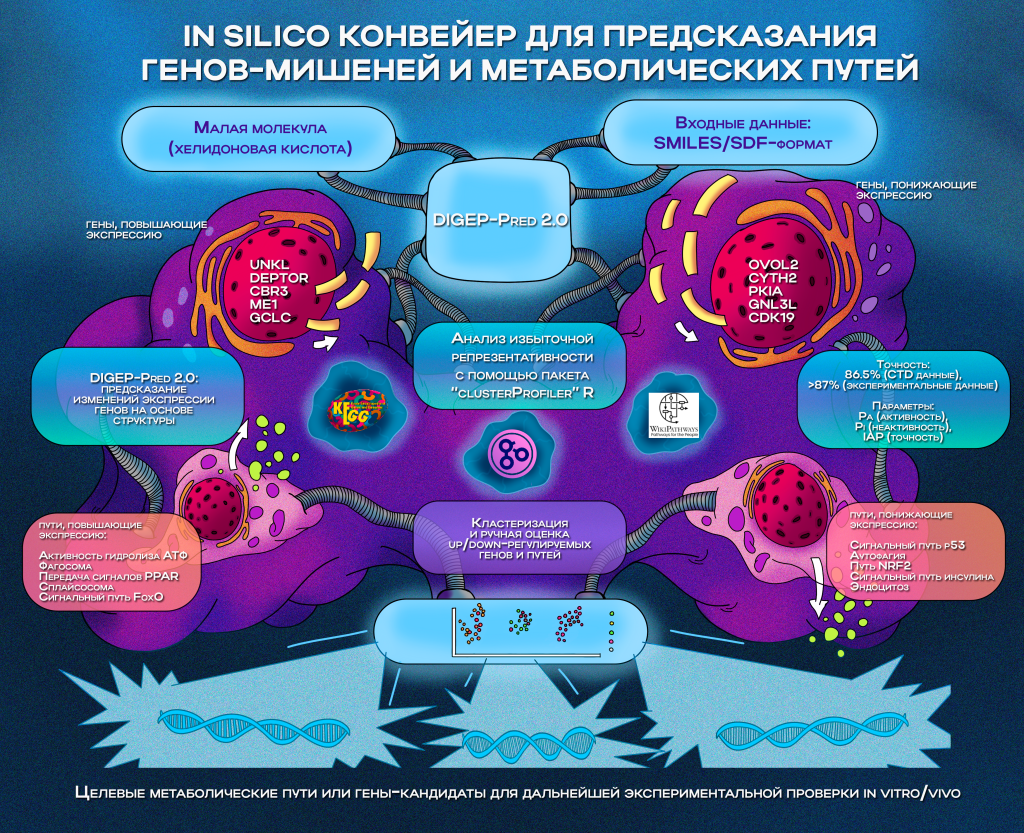
Современная фармацевтическая наука претерпевает значительные изменения благодаря активному внедрению компьютерных технологий в процесс разработки лекарственных средств. Перед традиционными этапами синтеза и экспериментальной проверки исследователи все чаще применяют in silico подходы, позволяющие с высокой точностью моделировать структуру и фармакологические эффекты химических соединений. Такой подход обеспечивает значительную экономию временных и финансовых ресурсов, оптимизируя последующие экспериментальные исследования. Параллельно с этим наблюдается активное развитие эпигеном-направленной терапии — нового подхода, позволяющего модулировать экспрессию генов, вовлеченных в патологические процессы, без прямого воздействия на первичную структуру ДНК. В данной работе на примере хелидоновой кислоты представлен комплексный алгоритм оценки влияния малых молекул на экспрессию генов и метаболических путей. Методика основана на использовании веб-сервиса DIGEP-Pred 2.0 с последующим многоуровневым биоинформатическим анализом, включающим: (1) анализ избыточной репрезентативности генов; (2) оценку вовлеченности метаболических путей; (3) их функциональную кластеризацию. Предлагаемый подход способствует решению задач как для фундаментальных, так и для прикладных исследований механизмов действия лекарственных веществ.
Abstract
Modern pharmaceutical science is undergoing significant changes due to the active integration of computer technologies into the drug development process. Prior to the conventional stages of synthesis and experimental testing, researchers are increasingly turning to in silico methods, which enable the simulation of the structure and pharmacological effects of chemical compounds with a high degree of predictive accuracy. This approach significantly saves time and financial resources, optimizing subsequent experimental studies. In parallel, there is an active development of epigenome-targeted therapy, a new approach that allows for the modulation of gene expression involved in pathological processes without directly altering the primary DNA structure. Using chelidonic acid as a case study, we present a pipeline for computer-based assessment of small molecule effects on gene expression and metabolic pathways. The algorithm is based on the use of the DIGEP-Pred 2.0 web service, followed by multilevel bioinformatics analysis, including: (1) gene over-representation analysis; (2) assessing the involvement of metabolic pathways; (3) functional clustering of pathways. The proposed approach can help solve problems in both fundamental and applied research on the molecular mechanisms of drug action.
Список литературы
- Paul S. M., Mytelka D. S., Dunwiddie C. T., Persinger C. C., Munos B. H., Lindborg S. R., et al. How to improve R&D productivity: the pharmaceutical industry’s grand challenge. Nat. Rev. Drug Discov. 2010, 9(3), 203—214, DOI: 10.1038/nrd3078.
- Swinney D. C., Anthony J. How were new medicines discovered? Nat. Rev. Drug Discov. 2011, 10(7), 507—19, DOI: 10.1038/nrd3480.
- Ekins S., Puhl A. C., Zorn K. M., Lane T. R., Russo D. P., Klein J. J., et al. Exploiting machine learning for end-to-end drug discovery and development. Nat. Mater. 2019, 18(5), 435—441, DOI: 10.1038/s41563-019-0338-z.
- Yang K., Swanson K., Jin W., Coley C., Eiden P., Gao H., et al. Correction to Analyzing Learned Molecular Representations for Property Prediction. J. Chem. Inf. Model. 2019, 59(12), 5304—5305, DOI: 10.1021/acs.jcim.9b01076.
- Anighoro A., Bajorath J., Rastelli G. Polypharmacology: Challenges and Opportunities in Drug Discovery. J. Med. Chem. 2014, 57(19), 7874—7887, DOI: 10.1021/jm5006463.
- Lyu J., Wang S., Balius T. E., Singh I., Levit A., Moroz Y. S., et al. Ultra-large library docking for discovering new chemotypes. Nature. 2019, 566(7743), 224—229, DOI: 10.1038/s41586-019-0917-9.
- Shaker B., Ahmad S., Lee J., Jung C., Na D. In silico methods and tools for drug discovery. Computers in Biology and Medicine. 2021, 137, 104851, DOI: 10.1016/j.compbiomed.2021.104851.
- Macarron R., Banks M. N., Bojanic D., Burns D. J., Cirovic D. A., Garyantes T., et al. Impact of high-throughput screening in biomedical research. Nat. Rev. Drug. Discov. 2011, 10(3), 188—195, DOI: 10.1038/nrd3368.
- Drews J. Drug discovery: a historical perspective. Science. 2000, 287(5460), 1960— 1964, DOI: 10.1126/science.287.5460.1960.
- Tang Y., Zhu W., Chen K., Jiang H. New technologies in computer-aided drug design: Toward target identification and new chemical entity discovery. Drug Discovery Today: Technologies. 2006, 3(3), 307—313, DOI: 10.1016/j.ddtec.2006.09.004.
- Dawson M. A., Kouzarides T. Cancer Epigenetics: From Mechanism to Therapy. Cell. 2012, 150(1), 12—27, DOI: 10.1016/j.cell.2012.06.013.
- Omarov M. A., Mulyukov A. R., Khalitov R. V., Safarov S. I., Ayupova G. U., Demianenko O. N., et al. Epigenetic modulation in medicine: Regulation of gene expression in the context of pathogenesis and therapy. Acta Biomedica Scientifica. 2024, 9(6), 22—33, DOI: 10.29413/ABS.2024-9.6.3.
- Allis C. D., Jenuwein T. The molecular hallmarks of epigenetic control. Nat. Rev. Genet. 2016, 17(8), 487—500, DOI: 10.1038/nrg.2016.59.
- Kelly T. K., De Carvalho D. D., Jones P. A. Epigenetic modifications as therapeutic targets. Nat. Biotechnol. 2010, 28(10), 1069—1078, DOI: 10.1038/nbt.1678.
- Huang G., Yan F., Tan D. A Review of Computational Methods for Predicting Drug Targets. Current Protein & Peptide Science. 2018, 19(6), 562—572, DOI: 10.2174/1389203718666161114113212.
- Sun X., Hu B. Mathematical modeling and computational prediction of cancer drug resistance. Briefings in Bioinformatics. 2018, 19(6), 1382—1399, DOI: 10.1093/bib/bbx065.
- Bender A., Glen R. C. Molecular similarity: a key technique in molecular informatics. Org. Biomol. Chem. 2004, 2(22), 3204—3218, DOI: 10.1039/B409813G.
- Poroikov V. V. Search for new pharmacological substances based on computer prediction of biological activity spectra. Laboratory and production. 2021, 1(16), 72— 80, DOI: 10.32757/2619-0923.2021.1.16.72.80.
- Filimonov D. A., Druzhilovskiy D. S., Lagunin A. A., Gloriozova T. A., Rudik A. V., Dmitriev A. V., et al. Computer-aided Prediction of Biological Activity Spectra for Chemical Compounds: Opportunities and Limitations. Biomedical Chemistry: Research and Methods. 2018, 1(1), e00004—e00004, DOI: 10.18097/BMCRM00004.
- Lagunin A., Ivanov S., Rudik A., Filimonov D., Poroikov V. DIGEP-Pred: web service for in silico prediction of drug-induced gene expression profiles based on structural formula. Bioinformatics. 2013, 29(16), 2062—2063, DOI: 10.1093/bioinformatics/btt322.
- Ivanov S. M., Rudik A. V., Lagunin A. A., Filimonov D. A., Poroikov V. V. DIGEP-Pred 2.0: A web application for predicting drug-induced cell signaling and gene expression changes. Mol. Inform. 2024, 43(12), e202400032, DOI: 10.1002/minf.202400032.
- Yu G. Thirteen years of clusterProfiler. Innovation (Camb). 2024, 5(6), 100722, DOI: 10.1016/j.xinn.2024.100722.
- Xu S., Hu E., Cai Y., Xie Z., Luo X., Zhan L., et al. Using clusterProfiler to characterize multiomics data. Nat. Protoc. 2024, 19(11), 3292—3320, DOI: 10.1038/s41596-024-01020-z.
- Wu T., Hu E., Xu S., Chen M., Guo P., Dai Z., et al. ClusterProfiler 4.0: A universal enrichment tool for interpreting omics data. Innovation (Camb). 2021, 2(3), 100141, DOI: 10.1016/j.xinn.2021.100141.
- Yu G., Wang L. G., Han Y., He Q. Y. ClusterProfiler: an R Package for Comparing Biological Themes Among Gene Clusters. OMICS: A Journal of Integrative Biology. 2012, 16(5), 284—287, DOI: 10.1089/omi.2011.0118.
- Yu G., Wang L. G., Yan G. R., He Q. Y. DOSE: an R/Bioconductor package for disease ontology semantic and enrichment analysis. Bioinformatics. 2015, 31(4), 608— 609, DOI: 10.1093/bioinformatics/btu684.
- Pagès H., Carlson M., Falcon S., Li N. AnnotationDbi: Manipulation of SQLite-based annotations in Bioconductor. AnnotationDbi, R package version 1.70.0. 2025, DOI: 10.18129/B9.bioc.
- Carlson M. org.Hs.eg.db: Genome wide annotation for Human, DOI: 10.18129/B9.bioc.org.Hs.eg.db.
- Tenenbaum D., Maintainer B. KEGGREST: Client-side REST access to the Kyoto
Encyclopedia of Genes and Genomes (KEGG). R package version 1.48.0. 2025, DOI: 10.18129/B9.bioc.KEGGREST. - Carlson M. GO.db: A set of annotation maps describing the entire Gene Ontology. R package version 3.21.0, DOI: 10.18129/B9.bioc.GO.db.
- Slenter D. N., Kutmon M., Hanspers K., Riutta A., Windsor J., Nunes N., et al. WikiPathways: a multifaceted pathway database bridging metabolomics to other omics research. Nucleic Acids Research. 2018, 46(D1), D661—667, DOI: 10.1093/nar/gkx1064.
- Gustavsen J. A., Pai S., Isserlin R., Demchak B., Pico A. R. RCy3: Network biology using Cytoscape from within R. F1000Res. 2019, 8, 1774, DOI: 10.12688/f1000research.20887.3.
- Avdeeva E., Shults E., Rybalova T., Reshetov Y., Porokhova E., Sukhodolo I., et al. Chelidonic Acid and Its Derivatives from Saussurea Controversa: Isolation, Structural Elucidation and Influence on the Osteogenic Differentiation of Multipotent Mesenchymal Stromal Cells In Vitro. Biomolecules. 2019, 9(5), 189, DOI: 10.3390/biom9050189.
- Avdeeva E., Porokhova E., Khlusov I., Rybalova T., Shults E., Litvinova L., et al. Calcium Chelidonate: Semi-Synthesis, Crystallography, and Osteoinductive Activity In Vitro and In Vivo. Pharmaceuticals. 2021, 14(6), 579, DOI: 10.3390/ph14060579.
- Kaufman L., Rousseeuw P. J. Partitioning Around Medoids (Program PAM). John Wiley & Sons, Inc. 2008, 68—125, DOI: 10.1002/9780470316801.ch2.
- Hennig C., Meila M., Murtagh F., Murtagh F., Rocci R., Eds. Handbook of cluster analysis. CRC Press. CRC Press: Boca Raton. 2015, DOI: 10.1201/B19706.
- Schubert E., Rousseeuw P. J. Faster k-Medoids Clustering: Improving the PAM, CLARA, and CLARANS Algorithms. In: Amato G., Gennaro C., Oria V., Radovanović M., Eds. Similarity Search and Applications. Springer International Publishing: Cham. 2019, 171—187, DOI: 10.1007/978-3-030-32047-8_16.
- Stokes J. M., Yang K., Swanson K., Jin W., Cubillos-Ruiz A., Donghia N. M., et al. A Deep Learning Approach to Antibiotic Discovery. Cell. 2020, 180(4), 688—702, DOI: 10.1016/j.cell.2020.01.021.
- Lavecchia A. Machine-learning approaches in drug discovery: methods and applications. Drug Discovery Today. 2015, 20(3), 318—331, DOI: 10.1016/j.drudis.2014.10.012.
- Elton D. C., Boukouvalas Z., Fuge M. D., Chung P. W. Deep learning for molecular design—a review of the state of the art. Mol. Syst. Des. Eng. 2019, 4(4), 828—849, DOI: 10.1039/C9ME00039A.